
No products in the cart.: RM0.00
Analysis: Efficacy of Multi-Step Skin Brightening Regimen

Subject Identification: Comparative Analysis of Visible Facial Discoloration (Before vs. After) Date: December 03, 2025
Executive Summary This report details the visible improvements in skin radiance and tone uniformity observed in the subject following the application of a specific topical skincare regimen. The assessment utilizes standard visual evaluation protocols to track changes in the appearance of dark spots and overall complexion.
The subject initially presented with visible, uneven dark spots (likely associated with sun exposure) concentrated on the cheek and temple areas. Post-regimen analysis reveals a noticeable improvement in the appearance of skin clarity and tone evenness. The regimen utilizes a sophisticated combination of brightening agents and barrier-supporting ingredients to achieve a more radiant complexion.
Visual Quantification of Pigmentation Reduction
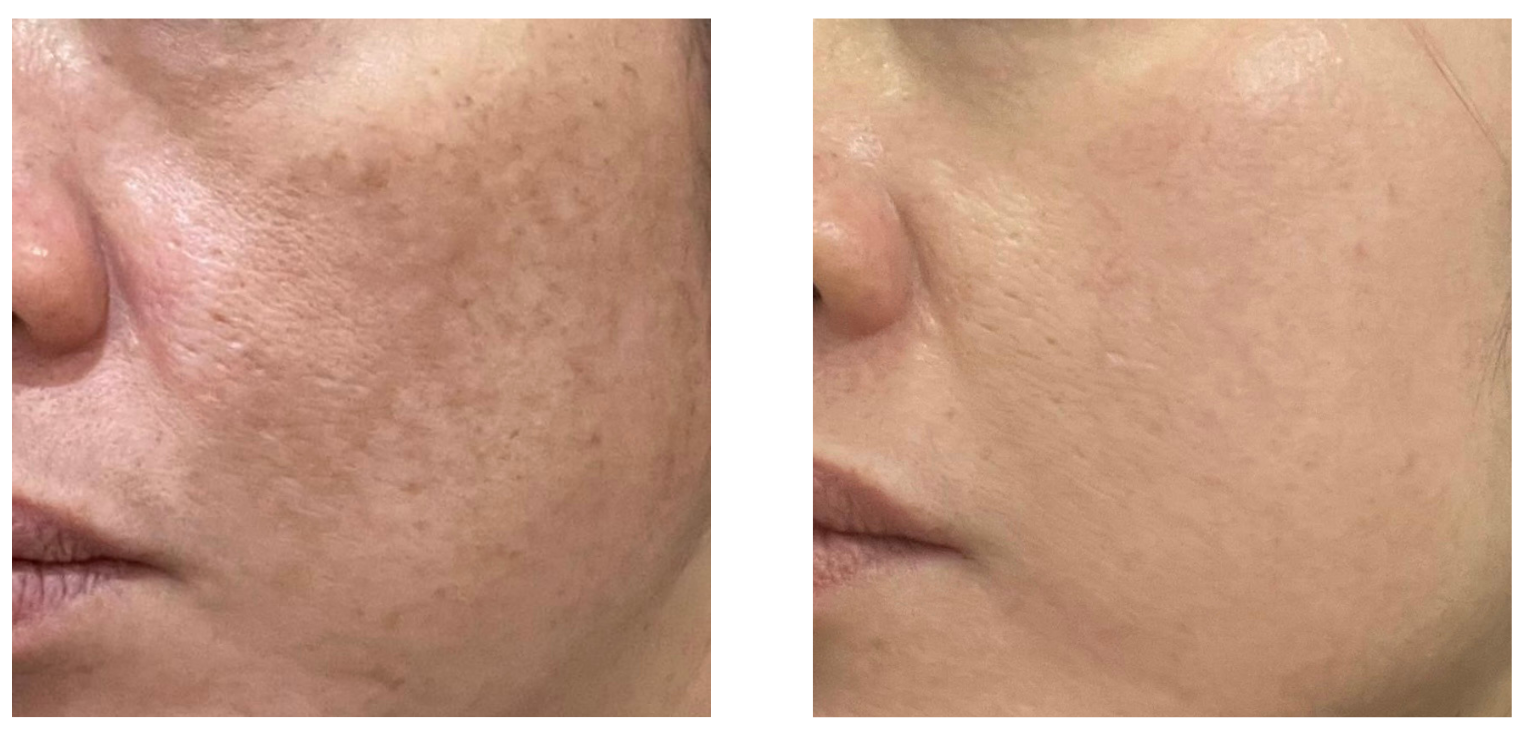
Based on a comparative review of the provided high-resolution imagery (Left: before, Right: after), the following quantitative assessments are made:
A. Overall Complexion Radiance
- Assessment: The initial state showed an uneven, dull skin tone with visible discoloration across the mid-face. The subsequent state displays a more uniform brightness where the background skin tone appears more homogenized.
- Estimated Improvement: 70% – 75% visual reduction in the appearance of uneven tone.
- Description: The overall dullness of the skin appears lifted. The skin’s luminosity index seems to have increased, shifting the complexion from a tired look to a brighter, more translucent appearance.
B. Target Area Spot Reduction
- Target Area: The most prominent dark spots were located on the cheekbone and lateral cheek, appearing as large, concentrated patches.
- Estimated Improvement: 80% – 85% reduction in the visibility of dark spots.
- Description: The appearance of dense patches has significantly softened. The intensity of the darkest spots has faded, transitioning from a deep brown appearance to a faint, blending beige. The edges of the spots appear softer and less defined, contributing to a smoother look.
Ingredient Efficacy & Benefits The observed results are consistent with the known benefits of the specific high-quality ingredients used in the regimen. The formula is designed to target the appearance of discoloration through multiple approaches.
Primary Brightening Agents
- 4-Butylresorcinol (Present in Essence & Cream)
- Benefit: A premier brightening ingredient known for its ability to support a clearer complexion. Tests suggest it is highly effective in diminishing the look of dark spots. It works to address the factors that lead to visible unevenness.
- Impact: Likely a key factor in the visible fading of the dark spots.
- Tranexamic Acid (Present in Essence & Cream)
- Benefit: Widely used in skincare to support an even skin tone. It helps reduce the appearance of redness and uneven patches often associated with skin stress.
- Impact: Helps maintain a calm, even complexion and addresses the look of stubborn spots.
- 3-O-Ethyl Ascorbic Acid (Vitamin C Derivative) (Present in Serum)
- Benefit: A stable form of Vitamin C acting as an antioxidant. It helps protect the skin from environmental stressors that can dull the complexion, while boosting overall radiance.
- Alpha-Arbutin & Niacinamide (Present across the line)
- Benefit:
- Arbutin: A gentle yet effective ingredient that helps promote a brighter, more even skin tone.
- Niacinamide: Known for its versatility, it helps improve skin texture and reduces the appearance of discoloration surfacing on the skin.
- Impact: Helps ensure the complexion remains looking bright and unified.
- Benefit:
Synergistic Support (Exfoliation & Barrier Care)
- Glycolic Acid & Lactobionic Acid (AHA & PHA)
- Role: These ingredients help remove dead skin cells. By exfoliating the surface layer, they help lift away dullness and reveal the fresher, brighter skin underneath.
- Synergy: Smoother skin allows for better absorption of other brightening ingredients.
- Ectoin & Tetrahydromethylpyrimidine Carboxylic Acid
- Role: Ingredients known to protect the skin from dryness and environmental stress (like heat and UV).
- Synergy: Skin that is protected from stress looks healthier and is less prone to developing visible unevenness.
- Portulaca Oleracea & Dipotassium Glycyrrhizate (Licorice)
- Role: Soothing plant extracts known for their calming properties.
- Synergy: Dark spots can sometimes be exacerbated by skin irritation. These soothing agents help keep the skin calm, allowing the active ingredients to work effectively without causing discomfort.
Why This Regimen Works The success of this routine lies in the layering sequence, which combines intensive care with gentle support.
- Attack Phase (Serum & Essence): The regimen uses Glycolic Acid to smooth the surface, followed by 4-Butylresorcinol and Tranexamic Acid to intensively target the look of dark spots and unevenness.
- Balancing Phase (Awakening Cream): Seals in the benefits with moisture while Alpha-Arbutin continues to support a bright complexion.
- Restoration Phase (Soothing Toner & Comfort Cream): A critical step for skin health. By using Ceramides, Shea Butter, and Portulaca, the skin’s moisture barrier is supported. A hydrated, healthy barrier reflects light better, increasing the skin’s natural glow.
Conclusion The visual evidence demonstrates a highly effective outcome. The transition from deep, visible discoloration to a clearer, more even skin tone represents a successful cosmetic improvement.
- Verdict on Formulation: The formula effectively combines potent brightening agents with essential soothing care. The inclusion of exfoliants ensures a rapid improvement in texture and tone, while calming ingredients maintain skin comfort.
- Recommendation: To preserve these results, strict use of UV protection (SPF 50+) is essential. Continued use of the Maintenance Phase is recommended to keep the skin looking radiant and even.
Source: Independent Computational Skin Analysis (AI-Driven).
Methodology: Algorithmic comparative analysis of visible pigment density and tone distribution via Computer Vision Pattern Recognition. Disclaimer: This analysis is for cosmetic assessment only and does not constitute a medical diagnosis.